MN3536
Hello, I am a third-year student studying Business and Management at the Royal Holloway University of London. I love being creative and I enjoy swimming as well as listening to music. I volunteer with the Scout Movement, therefore, I currently DBS certificate, and help/feature in the local Gang Show. I have also recently become a Red Cross certified lifeguard in America meaning I also have full certification in first aid training.
My first professional experience was helping science lab technicians at a school, I volunteered to help with preparation for classes after school, washing up and organizing storage cupboards. During this time I also took up babysitting which I have done for continuous years after, taking care of children aged 6 to 12 years old. I spent two weeks in a work experience setting within Boots the Chemist. At this job, I was responsible for stocking shelves, cleaning and helping with the customer’s inquiries. I participated in a lake district leadership development management trip. On this trip I spent a couple of days in the lake district, participating in team-building activities and tasks which improved my confidence and teamwork skills. My most recent job was at Camp Kennybrook. I spent the summer of 2019 working in a summer camp in America. I worked as a counselor and a lifeguard/kayaking instructor. I Learnt many different life skills undertaking a heavy amount of responsibility. My aspiration for the future is to become a manager in the marketing area of business. Or develop and sustain a charity that betters our Earth’s environment.
Blog Entry 1: Social Contagion
According to the Oxford Dictionary of Psychology, social contagion is the spreading of ideas, behaviors, and attitudes that pass on to people through a pattern brought on by conformity and imitation. This concept is studied in many practices as its logic is found so profusely in everyday social interactions. Not only in person but online, as well as being present on social media platforms also. There are a variety of different types of social contagion including emotional and behavioral, the persuasion of this concept can also be seen through religious beliefs and demographical influences.
On social media, social contagion can be seen through trends made popular by waves of users following them and also social influencers either starting or promoting them. Such examples are trends like the cinnamon challenge or the surge of people using TikTok. These instances create a domino effect that cascades through the online community inspiring others to follow. These platforms are of recent influence on a relatively new method of interaction. Social contagion is easier accomplished on social media as the users can hide their conformity to it through their screens and online personas. People called online influencers are otherwise known as these trend creators or followers. They are popular because they copy popular ideas for videos and posts and submit them to their followers. These social media influencers get paid through paid advertisements made on the content they make. Examples of this are the Kardashians/Jenner family all getting paid advertisements with Sugar Bear Hair. The way it works is the higher the social media follower the more money they are offered, as the great influence, they have to be able to persuade their fans to buy the promoted product. There is another side to social contagion which is less pleasing although it works similarly as the main method of marketing. Its not only trends and ideas that users are copying, its behaviours and lifestyles. For instance, the number of young people suffering from eating disorders is higher than ever thanks to social media influence on what body types should be. As well as this it brings an expected level of social acceptability as users believe they will be liked more if they follow these influencers.
This is because social contagion is not only the physical act of copying someone, it can mean to imitate emotion and as well as behaviours. This is what social contagion research has shown as they are the two main areas that it can be broken down into. As for emotional contagion, this could mean having feelings towards someone just because someone else has them. For example on social media scandals happen all the time as celebrities get caught up in the drama. Someone with little to no knowledge of the situation can create an opinion of it just through other users posted comments. This is thought to be harmful as it does not let individuals create their own opinion as they insist on agreeing with someone they admire, or with the popular majority. Behavioural contagion is the same but contains physical attributes, this one can lead to more harm.
In social experiments and testing, it has been confirmed that this is an issue in many areas of day-to-day life as most of our society is run on the principles of conforming to others. The same is said for online interactions. This ideal has been implanted in society since a very young age so theoretically there is no way around it as some suggest. But this is one thing that social media thrives on as recreating created content ensures the continuation of the platform.
Marsden, P. (1998). Memetics & Social Contagion: Two Sides of the Same Coin?, The Journal of Memetics: Evolutionary Models of Information Transmission, 2
Tedx Talks. (2018). Social Contagion | Zack Cicek | TEDxVancouverCollege, YouTube, Available at: https://www.youtube.com/watch?v=vcXB5G50NwE
Colman, A. (2008). A Dictionary of Psychology, Oxford University Press, 3 ed
Blog Entry 2: Social Networking Analysis
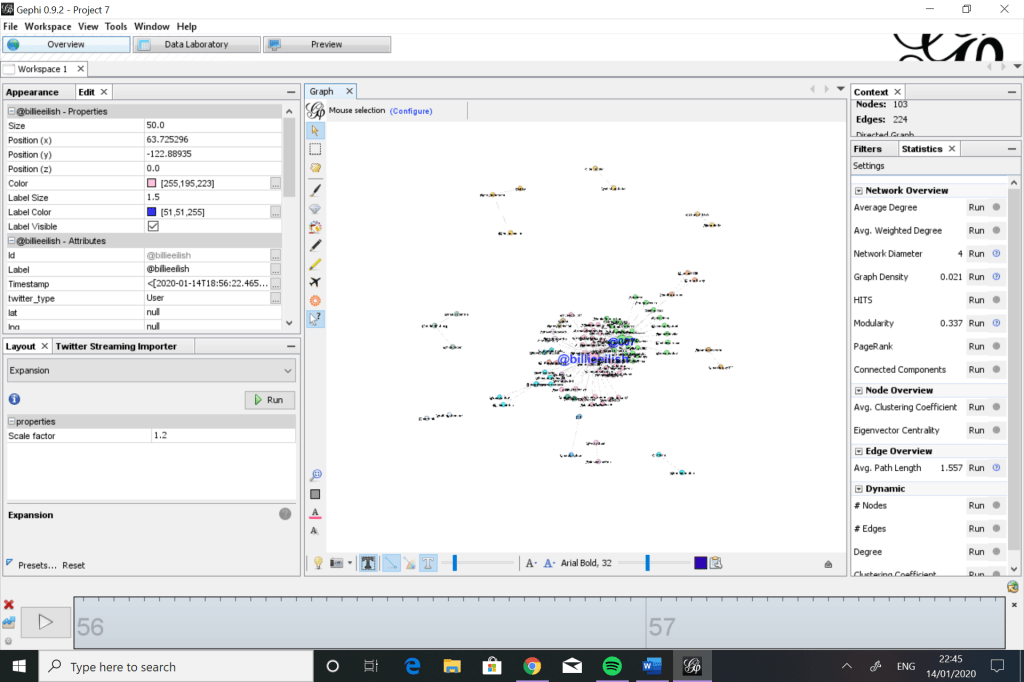
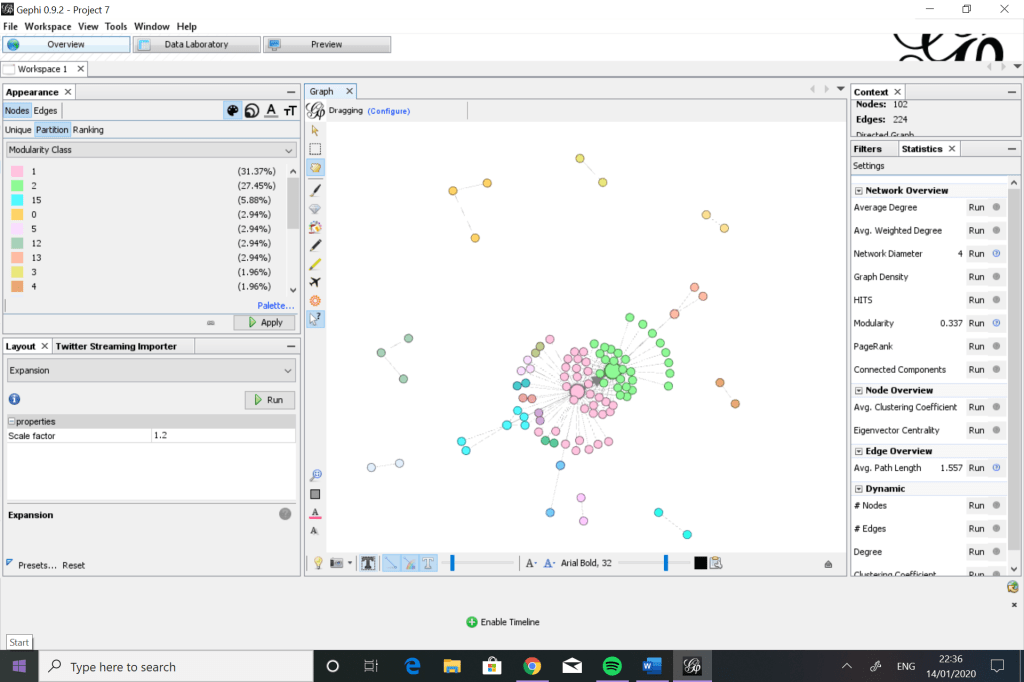
I completed a social networking analysis using Gephi, I analyzed the trending Twitter hashtag #NoTimetoDie in real-time data streaming to collect the information. The hashtag is about the recent news that singer Billie Eilish will be singing the new theme for the new James Bond movie. As this was a trending hashtag I only had to leave it connected for a short time to get a big enough collection of data to analyse. I ended up with 103 nodes with 224 edges to analyse, and I set up the logic on the Twitter streaming importer to apply to user networks. The different colors indicate the amount of modularity within this example. The biggest modularity groups are a part of the center cluster. The two biggest nodes which are in the center of this group are colored pink and green to easily identify any other nodes associated with them. The pink nodes are the first group of modularity, the node that is linked to every other pink node is the user @billieeilish who has a huge following on Twitter, therefore, the amount.t of attached nodes is not surprising. The bright green node is @007 and as a well-followed film franchise is also connected to many nodes from the release of information on the new movie. The amount.t of traffic a particular node has is identified through its size, the two nodes mentioned before are the biggest as they are popular accounts. The nodes that are not a part of this cluster are unrelated topic using the hashtag for a different meaning or tweets that have not mentioned or been retweeted from @billieeilish or @007’s post. All of the examples I have just talked about can been seen in the images published in this post.
Blog Entry 3: Reflection
Throughout this MN3536 Social Media, Networks, & Business module I have learned an overview of the history of social media and its relevance to business. Been able to have an understanding of the importance of social media and the role it plays in the structure and the marketing availabilities it has. This course has highlighted its significance concerning the current society as many businesses have started or solely operate online and use social media as a marketing tool. During the running of this course I have been taught various topics around the uses and psychological effects social media can have. Some of the topics included were social media business models and social media strategies and metrics. In these we looking into the way social media is used within an organization. Privacy and ethics of social media and network theories captured the less spoke about issues with the platform. As some of the challenges and matters within these topics can be the downfall in the practice of social media. Alongside these topics, I was educated in the practices of viral marketing by creating an organization’s Facebook page. As well as carrying out a social network analysis by using live streaming data on Twitter. To bring our understanding of this course to a close we are assessed on a group project in which we had to evaluate the social media presence of a chosen business, this practiced teamwork and the ability to divide work equally.
I have enjoyed this module as I found it interesting and entertaining. I love hearing about the ways social media can improve an organization or even start one as I believe it is the most valuable resource a business can have. I have always been interested in the marketing side of social media and the extent to which its power can create, in the form of turning regular people into influencers who promote products for money. Another side of the course I found intriguing was learning about the unethical privacy theories and harmful psychological effects social media can have. I found it to be something that needs to be discussed more as these issues can spiral out of hand quickly.
Overall I could have improved by starting work a little sooner as instructed by the lecturer as he was right about the amount of work that needs time to complete. I can see these practices within the real world. Even as I leave university there will most likely be more opportunities for social media to expand further for businesses. One example of social media being implemented in real-life situations is the process of hiring people. Employers can now search up potential employee’s social media profiles to see the kind of person they are and if they want to hire them. Many job-hunting users have used this to their advantage by making their social media profiles appealing to potential employers, even going as far as joining sites like LinkedIn. As I am interested in the marketing sector of an organization, social media will play a big part in that as most marketing strategies are done through social media.
 MN3536 Social Media, Networks, & Business